

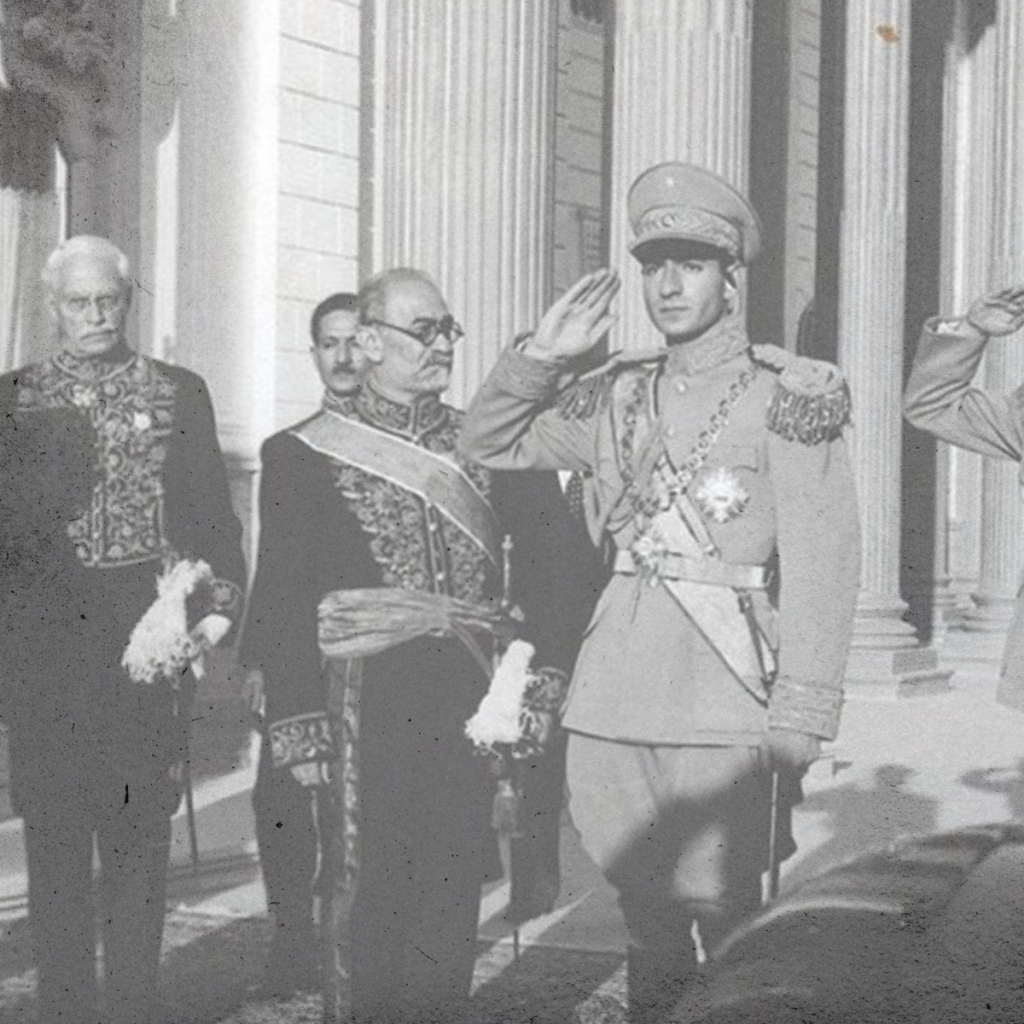
This is the transcript for Book Three, episode 1 of The Lion and the Sun podcast: Tehran Conference. This episode talks about Iran in World War II, Reza Shah’s Abdication, the Tehran Conference, and the Rise of Mohammad Reza Shah as the second king of Pahlavi. Listen to this episode on Apple Podcasts, Spotify or all other podcast platforms.
Reza Shah’s Forced Abdication in 1941: How the Allies Removed Iran’s King
“Promise me, friend.”
“Promise me!”
And with that, he turned.
Got into his car.
And left.
Reza Shah, the king of Iran, was banished from his country.
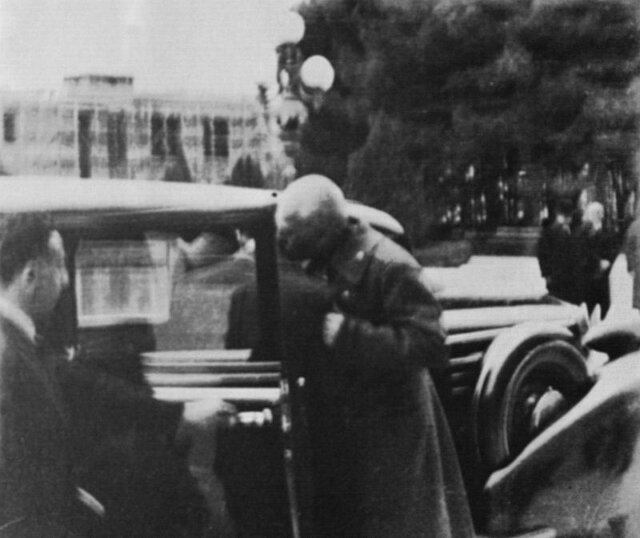
The final words were meant for Foroughi.
The king’s last prime minister.
He had made a promise to the abdicated monarch: to make sure his heir would claim the throne.
You see, Reza Shah’s abdication wasn’t by choice.
It was a conditional surrender to the Allies.
A punishment for backing the wrong side in the Second World War
The Allies would have their stability. They would gain access to Iran as a supply route.
And in return, the English and the Russians would spare the country they had invaded just weeks earlier.
But with the king gone, there was no one to ensure that his son would ascend to the throne.
The Allies didn’t care about the heir.
They didn’t even care for the Pahlavi dynasty.
Foroughi now had full autonomy.
The prime minister could’ve abolished the dynasty.
He could’ve ended the monarchy and declared a republic.
He could’ve even named himself president.
No one was there to stop him.
But Foroughi was a man of his word.
Despite his recent estrangement from Reza Shah, he would not break his promise.
He would make sure the heir gets his throne.
How Mohammad Reza Shah Came to Power: The Succession Crisis After Reza Shah
On September 16, 1941, immediately after Reza Shah’s departure, Foroughi went to the 21-year-old Mohammad Reza and got him ready.
He asked him to wear civilian clothes to blend in with the rest of the entourage and arranged for an old Chrysler to drive him to the parliament building.
Foroughi knew the Allies still held a grudge against Reza Shah and might try to block his son from coming to power, so he hid the young prince between the front and back seats of the car.
He also knew the main entrance to the parliament was always watched, so he snuck him in through the service door and hurried him into the main hall while an emergency session was called into action.
He didn’t waste a second on formalities.
Foroughi began the session by reading aloud Reza Shah’s abdication letter and announced that the king had left the capital:
“Considering that I have devoted all my strength over these past years to the affairs of the country and have become unable to continue, I feel that now the time has come for a younger, more vigorous power and foundation to attend to the nation’s ongoing affairs, and to provide for the welfare and prosperity of the people.”
The parliament went into a frenzy at the news … but Foroughi, the skilled orator he was, didn’t allow the hysteria to derail the session.
“By the grace of God, His Majesty the late ruler has a younger, capable, and beloved heir who, according to the Constitution, can immediately assume the reins of the monarchy of Iran.”
Then, without pause, he brought Mohammad Reza into the chamber.
The young man placed his hands on the Quran and was sworn into office.
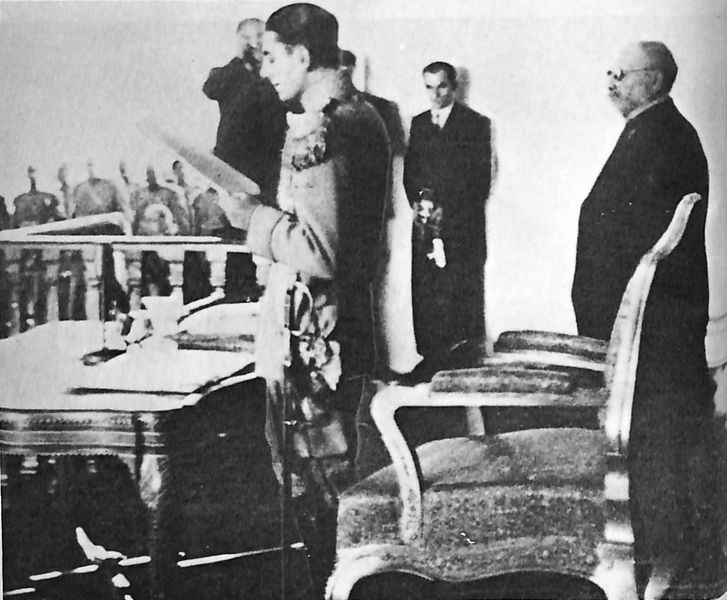
The last king of Iran was officially in power.
Iran in Crisis During World War II: Allied Invasion, Famine, and Unrest
When Mohammad Reza became the second king of the Pahlavi dynasty, Iran, by every measure, was in crisis.
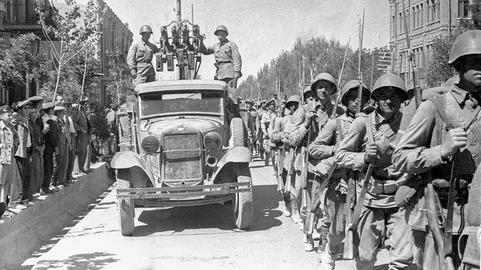
The Allied forces, fearing Reza Shah’s closeness to Germany, had invaded from both the north and the south.
Trade routes were closed.
Famine spread across the land.
What little food remained became so inflated in price that few could afford a daily meal.
The hunger and desperation led to unrest, with local conflicts erupting between ethnic and religious groups. Iran was a land of many identities: Arabs in the southwest, Kurds in the west, Turks in the north. As uprisings increased, so did fears that the country would fracture. That each group would secede and join others like them beyond Iran’s borders.
The new king was handed a country on the edge of collapse.
And few believed the 21-year-old Mohammad Reza had the strength to hold it together.
Mohammad Reza Shah’s Early Rule: Doubt, Modernization, and Political Survival
Mohammad Reza had entered the throne room with more ceremony than certainty.
Even his father doubted whether he had what it took to rule.
His childhood had been split between an elite Swiss academy and a military school in Tehran, meant to mold him into a prince fit to inherit an empire.
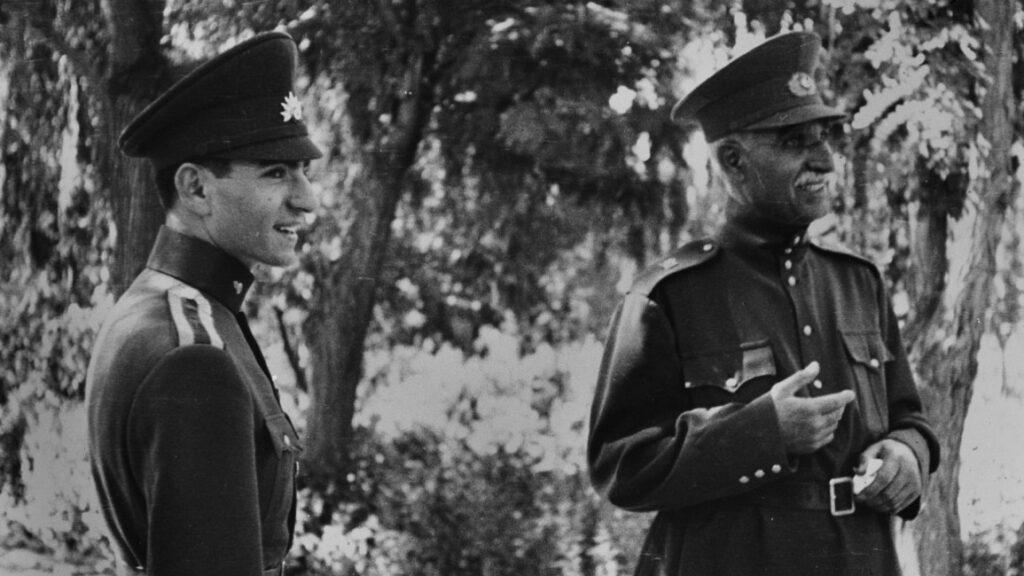
But none of it had prepared him for this:
When foreign soldiers marched through his streets and carved up the country he was suddenly responsible for.
Mohammad Reza had instincts: a belief that Iran could modernize, and that the monarchy should lead that transformation. He was brave in gesture: he flew planes, drove fast cars, carried himself with the confidence of a king.
But inner doubt haunted his every move.
When danger was close, he could hesitate.
Second-guess.
Retreat.
He feared losing allies, losing control and losing himself.
That tension defined his early days on the throne. He dreamed of bold leadership, but often stepped back from confrontation.
If the monarchy was to survive, he would need help from experienced men who could hold the line while he found his footing.
Fortunately, the young king had one such figure by his side.
A seasoned politician who knew how to navigate a crisis.
The politician was born into a literary household, so naturally, he spent his retirement reading and writing. He had entered the Majlis at the height of the Constitutional Revolution, becoming its speaker before the age of thirty-five. He had held the reins of both the Justice and Finance Ministries, crafting reforms that would outlive dynasties.
Mohammad Ali Foroughi: The Prime Minister Who Saved the Pahlavi Dynasty
Mohammad Ali Foroughi was once Reza Shah’s most trusted advisor. One of the chief architects of his rise to power.
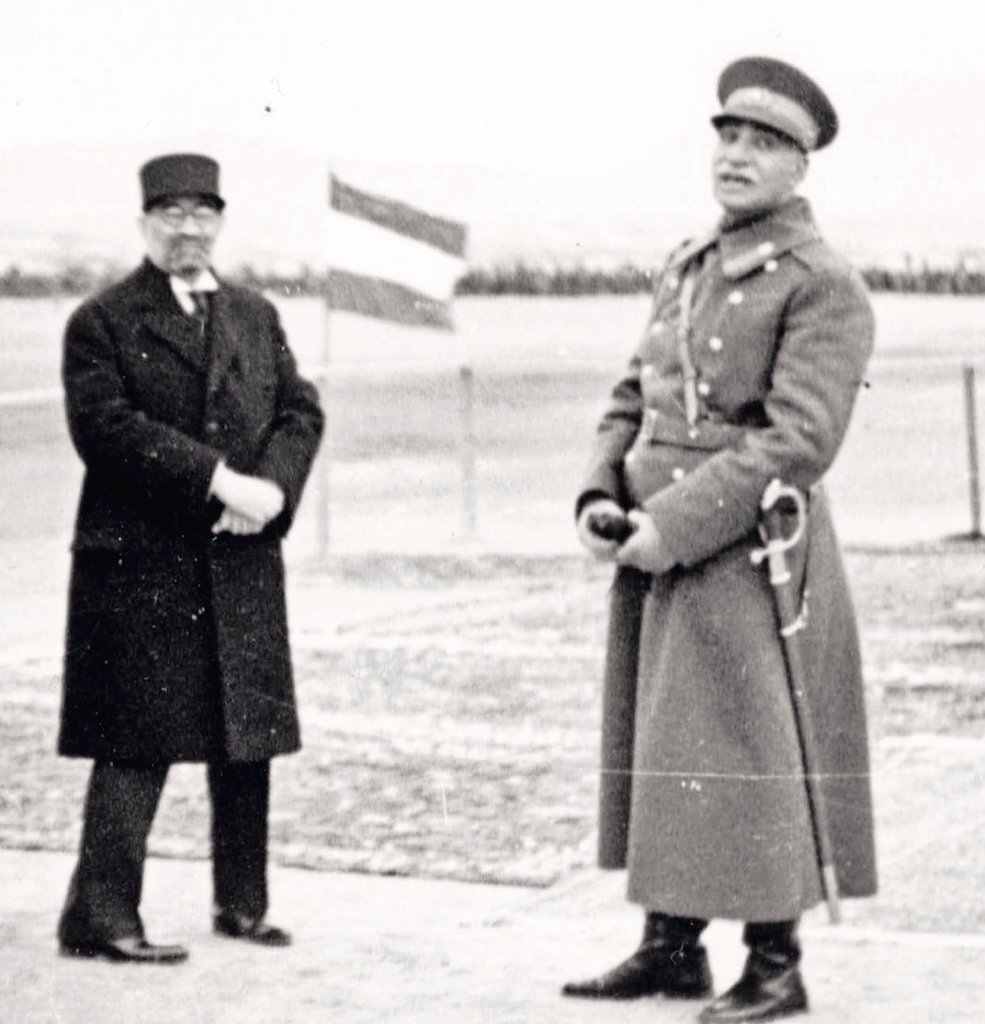
But that trust did not last.
As Reza Shah’s paranoia deepened, Foroughi was pushed aside. Stripped of his titles. Confined to house arrest for years.
Then, when the dynasty was crumbling, and no one else could hold the country together, Reza Shah turned back to the man he had cast away.
Foroughi returned not with bitterness, but with a mission.
His negotiation skills helped broker a delicate deal between Iran, Britain, and the Soviet Union.
The Allies wanted regime change. Foroughi gave them a compromise: remove the king, not the monarchy.
Let Reza Shah abdicate.
Place his son on the throne.
Now, that task has been completed. Reza Shah was gone. The young heir had taken the oath … And Foroughi found himself once again steering the country through crisis.
His first goal was to turn Iran from a passive victim of invasion into a cooperative partner with the superpowers. He made clear to the Allies that Iran would support the war effort, but only if they formally recognized the independence of the state they had just violated.
At home, resistance came from within the Majlis.
Many still believed Iran should remain neutral, just as it had in the First World War, but Foroughi met them head-on. The future of Iran, he argued, lay with the countries fighting the Axis, not with illusions about German sympathy.
He won the vote: 80 to 13.
The Tripartite Treaty of 1942: Iran’s Conditional Sovereignty Under Allied Occupation
Just like that, Iran broke its neutrality, declared war on Germany, and expelled all remaining German nationals.
With that vote, Foroughi secured both international and domestic legitimacy.
The path was now clear to formalize Iran’s alliance with the superpowers.
And from that moment, he began work on what would become the Tripartite Treaty.
The Tripartite Treaty guaranteed Iran’s territorial integrity and made a clear promise: British and Soviet forces would withdraw no later than six months after the end of the Second World War. In return, Iran pledged full cooperation to the allies: offering its roads, railways, telegraph lines, and labour to support the Allied cause. The treaty also required strict control over the press, forbidding any criticism of the occupation or disclosure of how Iran’s national resources were being used.
On 27 January 1942, the Majlis approved the Tripartite Treaty in Iran.
The law was finalized with the signatures of Prime Minister Mohammad-Ali Foroughi and the Russian and British ambassadors.
With the transition from Reza Shah to his son complete and the immediate threat to Iran’s sovereignty averted, Foroughi’s role was done.
The Death of Foroughi: The Statesman Who Stabilized Iran
Foroughi had fulfilled the promise he made to a banished monarch.
He had safeguarded the throne for the young king.
He had protected the country from a complete foreign takeover.
So, after months of crisis management, and with his health in sharp decline, Foroughi quietly resigned.
The storm had passed.
It was time for peace.
Before he could fully retreat into retirement, Mohammad Reza Shah offered him one final role, as Iran’s ambassador to the United States.
But Foroughi never made the journey.
On November 26, 1942, he suffered a heart attack and died at 65 years old.
In a single lifetime, Mohammad Ali Foroughi had been:
The first Prime Minister of the Pahlavi dynasty.
The last Prime Minister to serve Reza Shah.
The first Prime Minister to serve Mohammad Reza Shah.
Now, with his death, the young king was on his own.
When Foroughi stepped down, he believed he had secured Iran’s independence.
The treaty had been signed. The promises had been made.
The Allies had pledged to leave.
But history would prove otherwise.
The foreign hands that had invaded Iran in 1941 weren’t letting go anytime soon.
The Tehran Conference: Why Roosevelt, Churchill, and Stalin Met in Iran
On November 28, 1943, Tehran became home to the very first summit of the war for the allies welcoming the leaders of the Allied nations to Iran for the very first time.
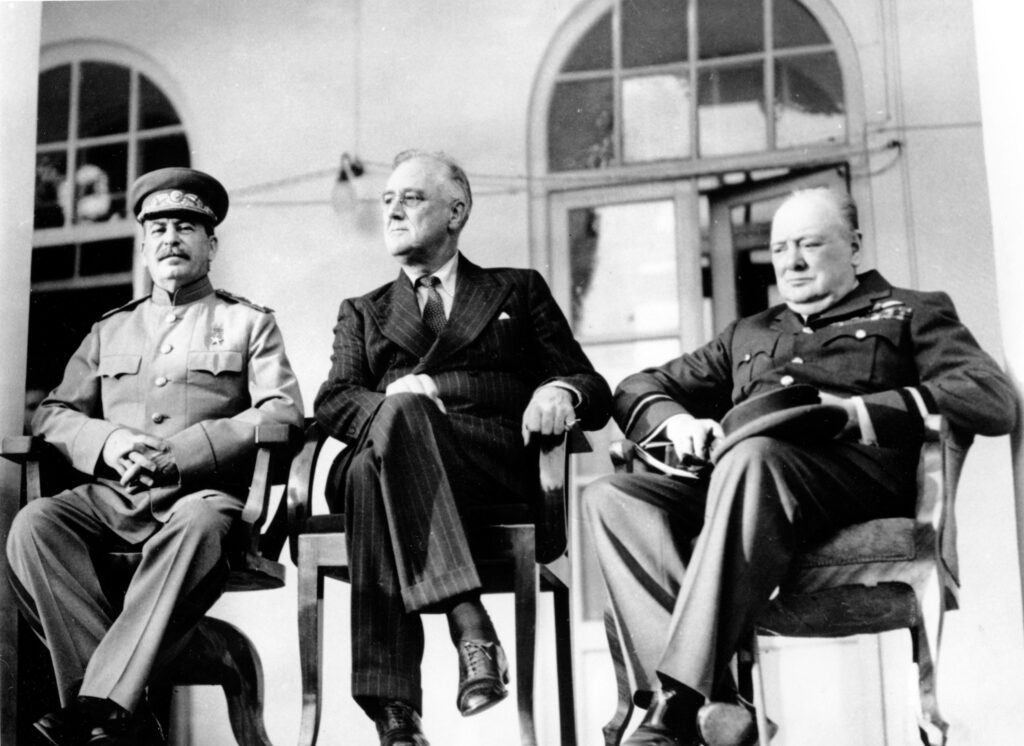
Stalin wanted Britain and the US to open a western front against Germany to relieve pressure from the soviet forces, and the summit was hosted in part to convince the United States and Britain of the agenda. The soviet embassy in Tehran hosted the summit, which both Churchill and Franklin D. Roosevelt attended.
At Tehran, each leader arrived with their own priorities, their vision on how they imagined the end of the war and what should follow afterwards.
Roosevelt came with the desire to transform the wartime alliance into a peaceful postwar partnership. He also hoped that by showing Stalin trust and friendship, the Soviet Union would continue to cooperate after victory, eventually becoming one of the guardians of a new international order built to prevent another global catastrophe.
Churchill’s mind was occupied by the fate of Europe. He worried about the cost and risk of a western front and preferred operations through the Mediterranean and the Balkans, where Britain already had influence and could potentially block Soviet expansion. He wanted to make sure the British Empire did not emerge from the war weakened and that countries like Poland would not simply be swallowed by its eastern neighbour.
Stalin, unlike the other two, carried the biggest weight on his shoulders. His country was invaded and had bled more than any other Allied power. His armies were doing most of the fighting, and he was determined to make the others feel that urgency. Russia’s overriding demand was the immediate opening of a second front in Western Europe to pull German divisions away from the Soviet east.
Iran at the Tehran Conference: Host Nation Without a Voice
The only item lost in this crowded agenda: the country playing host to the summit.
The organization of the summit was a humiliation for Iran and its government.
Iran was the host but not a participant.
The Allies chose Tehran as the location because it sat on the supply route feeding the Soviet war effort, but they never treated Iran as a partner in the talks.
The Iranian government wasn’t consulted about the date, wasn’t allowed to sit in on the high-level meetings, and learned details only after the decisions were already made.
The shah was granted brief, polite meetings with the leaders, mainly for photographs and protocol, but he had no influence on the negotiations.
During the conference, Iran was present only as the ground beneath the table rather than a voice at it; but the country did ultimately benefit from the event.
The Tehran Declaration and the Promise of Iranian Sovereignty
“The Governments of the United States, the U.S.S.R. and the United Kingdom are at one with the Government of Iran in their desire for the maintenance of the independence, sovereignty and territorial integrity of Iran.”
The official statement highlighted Iran’s sovereignty, but neither the British nor the Soviets were keen on taking the promise seriously.
For the British, independence was nothing but formality.
They had spent decades shaping Iranian politics through informal channels: they controlled the country’s oil, had allies in government and the Majlis, and knew every lever worth pulling.
The Soviets had even less regard for the pledge. Stalin believed in force, not declarations. He had already secured everything he needed from the conference. A vague promise made in Tehran was not going to get in the way of any future action.
Only the United States seemed serious about upholding its word.
The U.S. had no history of colonial rule in Iran. Unlike its allies, it wasn’t there to protect imperial assets. Its foreign policy at the time leaned on principles of self-determination, and its leaders saw an opportunity to play a stabilizing role in the region.
Roosevelt and the Atlantic Charter: Early US–Iran Relations in WWII
A year earlier, as the British and Soviets marched into Iran, the United States had announced the Atlantic Charter. It outlined a vision of a post-war world with no territorial expansion, where people had the right to choose their governments, access resources fairly, and enjoy peace through cooperation, not conquest.
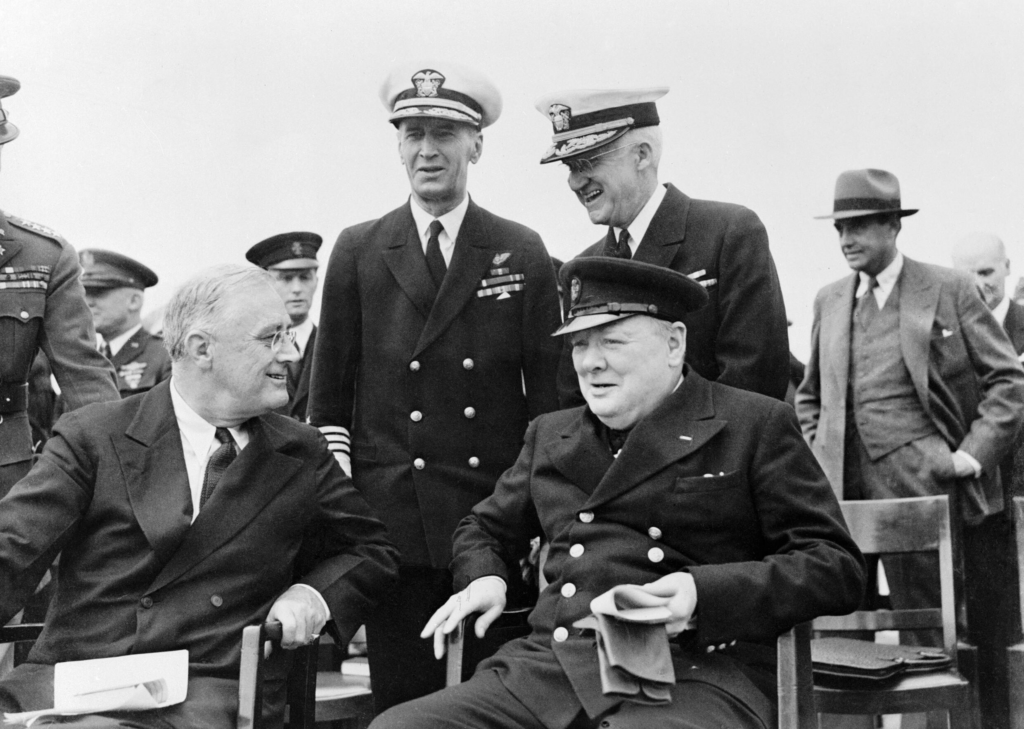
And when it came to Iran, many American officials genuinely believed they could make a difference.
They saw a country at the heart of the region. Rich in history. Rich in oil.
And, most importantly, not yet claimed by an empire.
For them was the beginning of a new chapter.
One where the United States would become more than just a distant observer in Iran’s affairs.
Franklin D. Roosevelt looked toward Iran with a hopeful vision that reached beyond the wartime need for supply routes and alliances. He saw a broader possibility: that Iran could become a testing ground for a different kind of foreign policy: one rooted not in exploitation but in partnership.
During his time in Tehran, he was genuinely struck by the country. In 1944, after the Tehran Conference, he wrote a letter directly to Mohammad Reza Shah. Rather than discussing politics or oil, Roosevelt focused on something as simple as the land itself. He described the dry slopes and barren mountains that framed the plains. What stayed with him was the absence of trees. He proposed a plan: Iran should experiment with reforestation, planting trees whose roots could anchor the soil and prevent floods.
He believed the United States could offer something the British and Soviets never had, a relationship without strings, one based on respect rather than control. It was a vision meant to resonate with Iranians who had grown weary of colonial pressure. Roosevelt was convinced that sending capable, sincere American experts could help bring that vision to life.
America’s Strategic Vision: Oil, Geography, and Postwar Influence
For Roosevelt, the bare mountains symbolized potential, not just for growth, but for the kind of nurturing relationship he hoped the U.S. could build with nations like Iran.
At the same time, American policymakers were waking up to a new world reality. The postwar world wouldn’t allow for isolation. Iran, positioned along the Persian Gulf and near U.S. oil interests in Saudi Arabia, had strategic importance that couldn’t be ignored.
In Roosevelt’s vision for peace, the great powers would each hold influence within their spheres, but they would also work together to avoid conflict.
Iran was central to this grand design.
If Britain and the Soviet Union couldn’t manage cooperation in a country like Iran, what hope was there for global unity?
To many Iranians, America’s arrival felt different.
The U.S. wasn’t seen as a colonial empire. It came without a history of manipulation. So when Americans showed up, they were welcomed. Not just as allies, but as possible mediators.
A third force that could keep the other two in check.
A potential partner that might finally treat Iran not as a pawn, but as a nation.
But this newfound friendship with the United States wasn’t the only transformation reshaping Iran after Reza Shah’s abdication.
A Political Awakening: Press Freedom and the Rise of Tudeh After 1941
As you might remember from the previous book, during his reign, Reza Shah concentrated authority in his own hands by weakening every single institution that could challenge him.
He reshaped Iran’s political system into an autocratic structure, sidelining the Majlis by handpicking its members and reducing it to a ceremonial body that merely confirmed his decisions. Political life effectively disappeared as parties were outlawed and critics faced intimidation, imprisonment, exile, or even assassination.
His control extended to the flow of information as well: independent newspapers were shut down, all publishing required state approval, and a government-run press replaced free journalism with official propaganda.
When Reza Shah abdicated, it was as if a weight of oppression was lifted from the nation.
The iron grip loosened.
The pressure lifted.
And in the space that followed, a political awakening took shape.
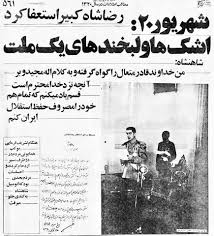
Newspapers reappeared. Political parties took shape. Labour unions and social organizations began to organize in public again. Tehran alone, where only a third of the population could even read, saw forty-seven newspapers begin publication. Twenty-two political parties became active in a city still reeling from war and famine.
Among them was Toudeh, which was founded by former political prisoners and educated activists who promoted Marxist-leaning social reform. It quickly grew into a major force among urban workers and intellectuals, organizing powerful trade unions and securing labour rights. By the end of World War II, it had become one of Iran’s most influential mass political movements and a key player in future events. But that’s for another episode.
Mohammad Reza Shah’s Oath: New Beginnings After Allied Occupation
The new king was young, barely 21, and the crown had been handed to him not through ceremony, but under the shadow of a foreign occupation.
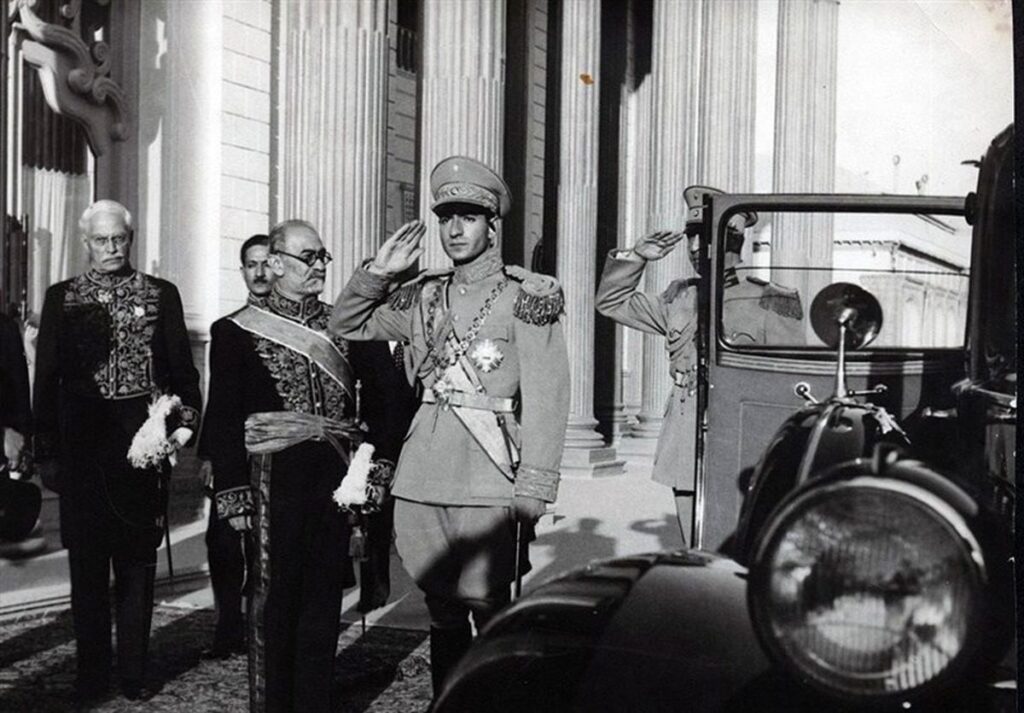
His people had celebrated the downfall of his father.
He had no legitimacy of his own yet not in the eyes of the public, and not in the eyes of the international community.
So to maintain control, he had to do something his father never would have: share it.
He couldn’t govern by force. Not yet anyway.
He needed allies. And for that, he had to lean on the very institutions his father had crushed.
To gain control of Iran, Mohammad Reza had to let go of it first.
“In the name of Almighty God – I call upon the all-powerful Lord as my witness, by the Holy Quran and by all that is sacred before God, I swear that I shall devote all my efforts to preserving the independence of Iran, safeguarding the country’s borders, and protecting the rights of the nation. To have constant and complete cooperation between the Government and the National Consultative Assembly and I shall guard the Constitutional Law of Iran and rule in accordance with it and the laws enacted under it.”
Standing next to Foroughi, on the day of his father’s abdication, this was the oath that placed Mohammad Reza Shah on the throne.
A promise of a new beginning.
Of a brighter future.
Infinity Cycle: Hope and Despair in Modern Iran
It is often said that history does not repeat itself, but it does rhyme.
Its a theme that we’ve come back to again and again in this show.
In Iran’s history, this rhythm has been a cycle of rising hopes and crushing disappointments.
A constitutional revolution brought the promise of a representative government, followed by a tyrannical king who shut it down.
A civil war rekindled the dream of democracy, then came a world war that swept it all away.
A republic was imagined, only to be replaced by yet another dynasty.
A nationalist king rose with visions of progress, only to spiral into paranoia and destroy the very foundations he built.
By the 1940s, the Iranian people had grown numb to hope. They had seen too many promises broken, too many moments of change fade into repetition.
But in 1944, something stirred again.
A new monarch, young and untested, spoke of safeguarding the land.
Foreign powers that had once dictated Iran’s fate now promised to protect its independence.
And at home, political life was reviving, a renaissance of newspapers, parties, and voices once silenced now echoing again through the streets.
For people who had endured revolutions and invasions, shortages and famines, coups and occupations, this glimpse of possibility felt almost unfamiliar. But it looked real.
Once again, Iranians allowed themselves to believe.
But history had taught them something else, too.
That when hope rises in Iran, crushing disappointment often follows.



2 Responses